Historian and futurist Mathieu Baudin moves between the past, present, and future to help people understand our times and envisage what lies ahead. Are we living in a unique era that could be likened to a new Renaissance?
You describe yourself as a historian and futurist. What does this wide temporal gap involve? I like to describe myself as a temporal explorer: going beyond today to look at yesterday and tomorrow. Exploring the future means imagining what could be better; exploring the past means rediscovering what we have lost. This journey through the future and the past sheds light on the present. Ultimately, history and foresight are both narrative arts. Humans are a storytelling species, and what we tell ourselves influences reality.
How would you describe the period we are going through? Are you proposing a different interpretation of the present? Depending on your mood, you might see similarities between our era and the 1930s... or even the end of the Roman Empire! But I prefer to see it as a new Renaissance.
At that time, just as today, the general feeling was one of perpetual multi-crisis: religious wars, scientific discoveries, and cultural upheavals. In this context of significant change, the contemporaries of the Renaissance showed great humility by questioning their geocentric model, recognising that our planet was just one star among many.
What we need to achieve today is even greater humility: to shift the focus away not only from the Earth but from the human. To restore our symbiosis with all living things. To complete the Copernican revolution, in a manner of speaking. The laws of life remind us that, in times of scarcity, cooperation is more evolutionary than competition. Moreover, the evolution of language reflects this shift. We are moving from a mechanistic language (‘boxes’, ‘incubators’) to a language of life (‘ecosystems’, “symbiosis”, ‘cooperation’, etc.). We are undergoing a major transformation: a revolution in the living world. Committing fully to it requires boldness and courage: there is a story to be told.
Credit: IMS Luxembourg
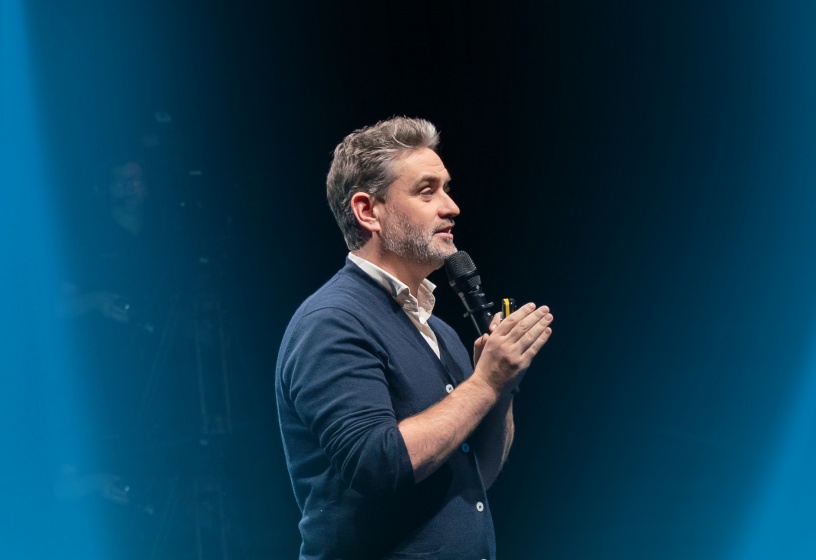
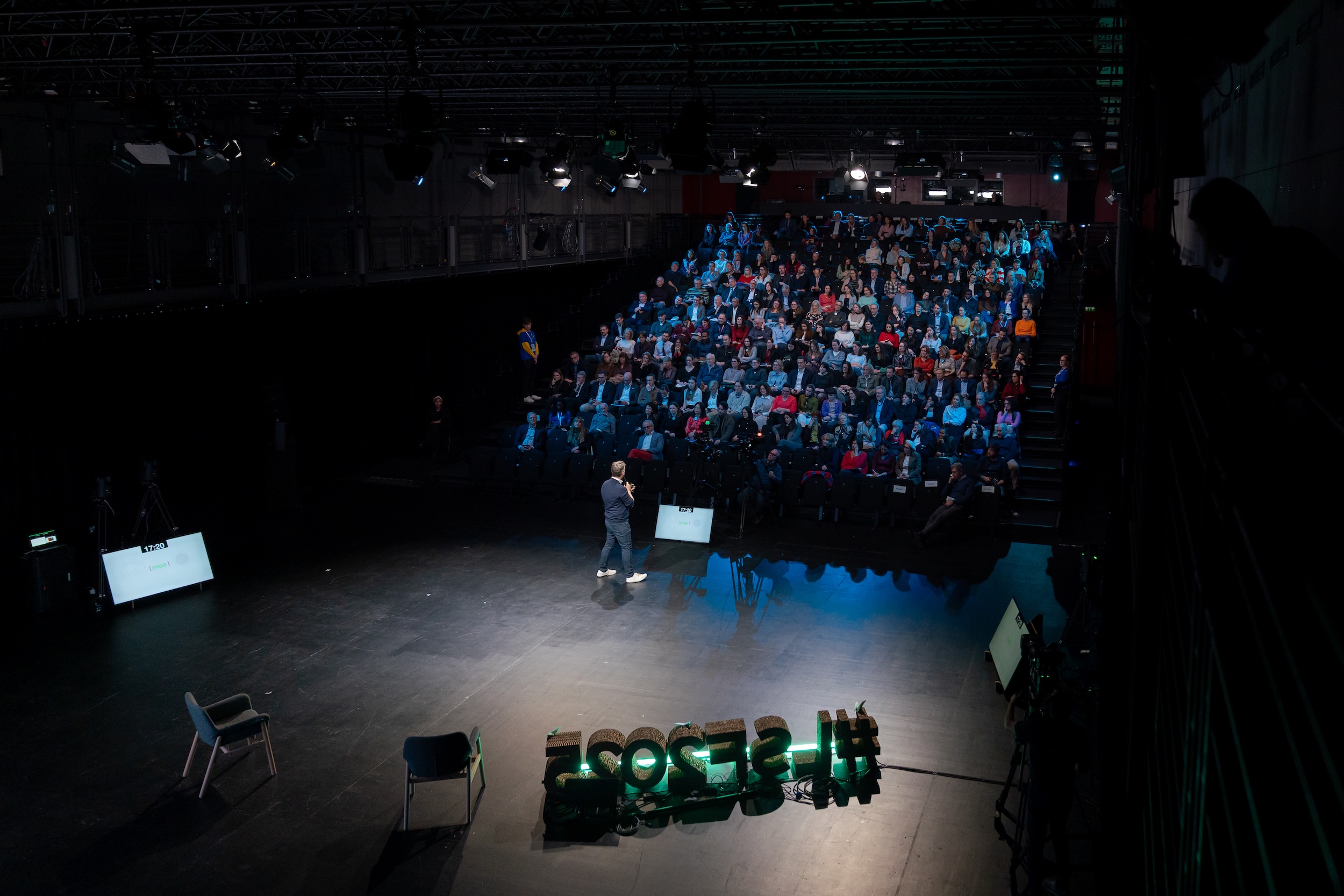
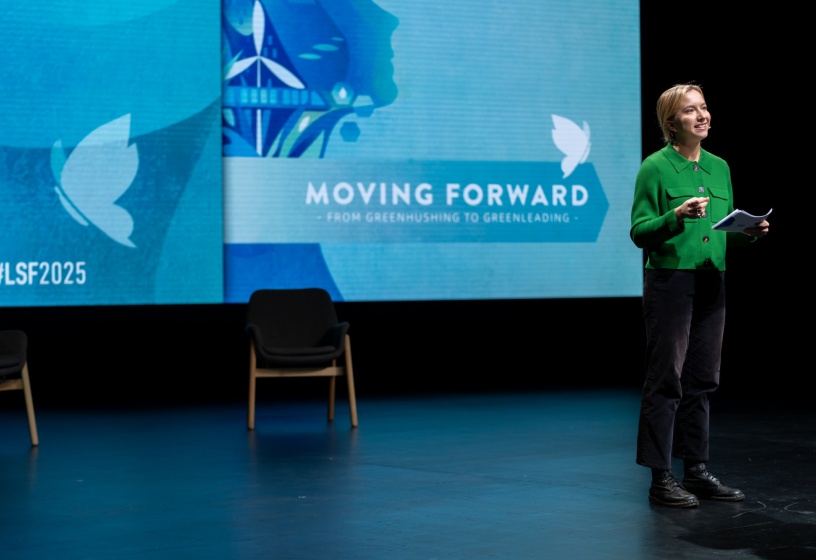
Mathieu Baudin at the Luxembourg Sustainability Forum 2025.
Is this an invitation to take a step back at a time when many people feel disoriented by the multitude of issues at stake? Yes, because looking at the horizon is essential. Asking ourselves about the horizon means asking ourselves, ‘Where are we going?’. It is urgent that we take the time to understand the times we live in: to slow down, to give ourselves perspective so that we know where we are going.
It is essential to take a step back, to breathe and to inspire. Today, we lack a common breath, a collective movement. Hence the importance of creating spaces where we can breathe together, conspire in the Latin sense of the term: conspirare, ‘to breathe with’.
However, for many, the future seems bleak or at least difficult to imagine positively... There is a time for loss, of course, but loss is a necessary part of future rebirths. We are entering a difficult winter, but how we get through this and how we look forward to the upcoming spring is up to us. The art of imagining futures is essential: it means broadening our horizons, putting the present into perspective, and giving ourselves collective momentum. It is about rethinking the game, from businesses to states to individuals. In my opinion, reimagining is the key.
A beautiful image to illustrate this is the metamorphosis of the caterpillar into a butterfly. During the transformation process, the new cells are first attacked by the old system, in a reactionary logic. Then, when they become too numerous, the chrysalis forms. It is a pause, a sacred moment. And then comes the butterfly. Biologists have decided to call these cells "imaginal cells" because stories, so imagination, are the prerequisites for any great transformation.
‘The art of imagining futures is essential: it broadens horizons, puts the present into perspective, and gives us collective momentum.’
You are a futurist: what role do you see sustainability playing in the future? In my opinion, sustainability is not a goal: it is the foundation on which we must rethink everything. It is truly the fertile ground from which to rethink all our activities. We have no choice: it is a matter of humanity's survival. But the good news is that what we need to do to survive is also what we should do to find happiness.
How can we prepare for the future? By taking the time. The Greeks and Romans had a word for this: skholè, otium. A time to build ourselves up, develop our critical thinking, converse with others and ourselves, and cultivate curiosity. We have lost that time. Yet it is perhaps the most powerful and least expensive remedy for preparing for the future.
Watch the replay of Mathieu Baudin's speech at the luxembourg Sustainability Forum 2025 here.
To be read also in the dossier "Facing Backlash, Staying the Course Towards Sustainability"