In light of the current backlash, François Gemenne revisits the reasons behind the questioning of the ecological narrative and puts forward ideas for answering the pressing questions of today: How can we unite around the issue of sustainable development? How can economic actors act in this period of uncertainty?
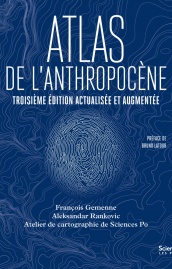
Atlas of the Anthropocene, which you co-authored with Aleksandar Rankovic, was published in its latest edition last August. Why did you write this book?
Today, we are seeing a significant weakening of the common ground for understanding climate and environmental issues, with the creation of very different spaces of realities. The very idea behind this Atlas is to provide a common assessment of the problem by bringing together all the necessary data. The solution to the problem depends greatly on how we perceive it and therefore on the information we have at our disposal. That is why I believe this Atlas was necessary.
Paradoxically, at a time when the scientific evidence is indisputable, the voices that refute it are becoming increasingly audible...
Yes. The reality of climate change is now widely accepted, and it is precisely because this scientific consensus has been taken up by politicians, industrialists, businesses and society as a whole, that it has become the target of conspiracy theories. These attacks are intensifying, and the great challenge is to avoid falling into a spiral of silence where a widely held majority opinion feels like a minority and therefore remains silent. I think an important issue in the public debate is to make the voice of the majority heard.
What went wrong? Has environmentalism become too ideological, too polarising?
Indeed, I fear that environmentalism has become too ideological and too polarising, and I think we were a little naive in imagining that there would be a spontaneous rallying under the banner of environmentalism, when it covers issues that tend to divide people. We underestimated the divisions that this would create, particularly on issues of social redistribution. As a result, environmentalist discourse has often been perceived as patronising or guilt-inducing, coming from relatively wealthy people who were not faced with the same issues or tensions as ordinary people. There is also the issue of the activists who are put forward and denounced by some: often relatively well-off young people with a certain amount of social and cultural capital to invest in these issues, whose discourse is sometimes perceived as disconnected from the experiences of ordinary people.
‘I fear that environmentalism has become too ideological and polarising.’
Last autumn, Spanish activists campaigning for veganism poured paint over a painting of Christopher Columbus in protest of neo-colonialism. Is it typically these methods and this combination of struggles that you denounce?
The stated aim of these shock tactics is to divide opinion. However, what made the climate protests organised by Greta Thunberg so successful was precisely that they brought together people of different ages, social classes and political persuasions. Shock tactics, on the other hand, seek to organise camps and make ecology an ideological marker. In doing so, they strengthen their own camp in a way, but alienate many people who ideologically do not identify with the struggles associated with ecology: against neo-colonialism, against capitalism, for class struggle, etc. They cut themselves off from part of public opinion and thus lead to a phenomenon of political and sociological rejection that affects not only climate policies, but sometimes climate science itself.
So how can we bring people together? That is the big question.
I see two complementary ways.
Firstly, for many people today, the transition is at best synonymous with constraint, at worst with regression. We need to make the transition a narrative and a project for progress. Not just technological progress, but also political, social and human rights progress. This is vital for our democracies, because if we fail to project ourselves positively into the future, we risk wanting to take refuge in the past, as we are currently seeing in the United States.
Secondly, we must embody this project because the narrative alone is not enough. It must be manifested in concrete terms in people's daily lives, in terms of transport, housing, food and leisure. People need to see that the transition is in their interest, that it brings them benefits and not just costs, constraints or sacrifices.
I believe this is fundamental.
Which nations are looking to the future?
Unlike the United States, which is nostalgic for a largely fantasised past, China is very much focused on the future, both in terms of its best aspects, namely the energy transition, and its worst, particularly on the issue of social control.
For China, this is not an expression of ecological awareness, but clearly a project to modernise its economy. It is also an ambition for geopolitical power on the world stage, as China has clearly understood that the 21st century will be electric and obviously intends to be an electric superpower.
‘China has clearly understood that the 21st century will be electric. It intends to be an electric superpower.’
Let's talk about businesses. In an increasingly uncertain environment, how do you see their attitude towards sustainable development?
Not all companies are equal in this regard. Some have understood that their transition to sustainability is a prerequisite for their future profitability and have undertaken significant changes, including, in some cases, transforming their business model. Others are adopting a wait-and-see approach, as if climate change were a temporary crisis. In doing so, they are taking the risk of being left completely behind in the 21st century economy. And then, as we speak, there are many companies that are wondering how to move forward. They are unclear about the regulatory or tax landscape and are hesitant to embark on transformations. The challenge, I believe, is to try to engage these companies, telling them not to expect everything from political measures and that they too can play a role in the continuity they are calling for.
Luxembourg is an important financial centre. You have dedicated a new section to this sector in your book. What is your message?
Finance remains a huge blind spot in the transition today. A lot of investments are still devoted to projects that counter the transition, such as fossil fuel extraction and deforestation. It is essential to redirect these flows.
At a time when we lack the money for sustainable development, I believe we are relying far too much on public authorities. Some of our savings could be very usefully redirected to finance local transition projects. This is both necessary for the climate and in the interests of savers.
There are, of course, some positive initiatives, but the challenge is to accelerate them. The big questions for finance professionals are: How can we deploy on a larger scale a whole range of sustainable investment vehicles that sometimes exist but only to a limited extent? What macroeconomic instruments should be developed to maximise the profitability of these investments? How can we make savings more transparent, given that many savers have no idea what their money is being used for? The financial sector has not been given sufficient consideration, yet it is in fact an extraordinarily powerful lever for action and key to the success of the transition.
Credit: IMS Luxembourg
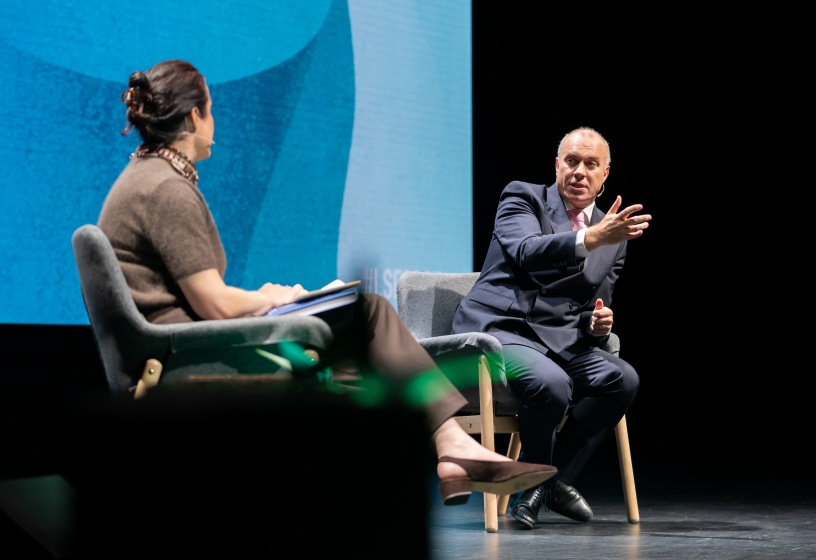
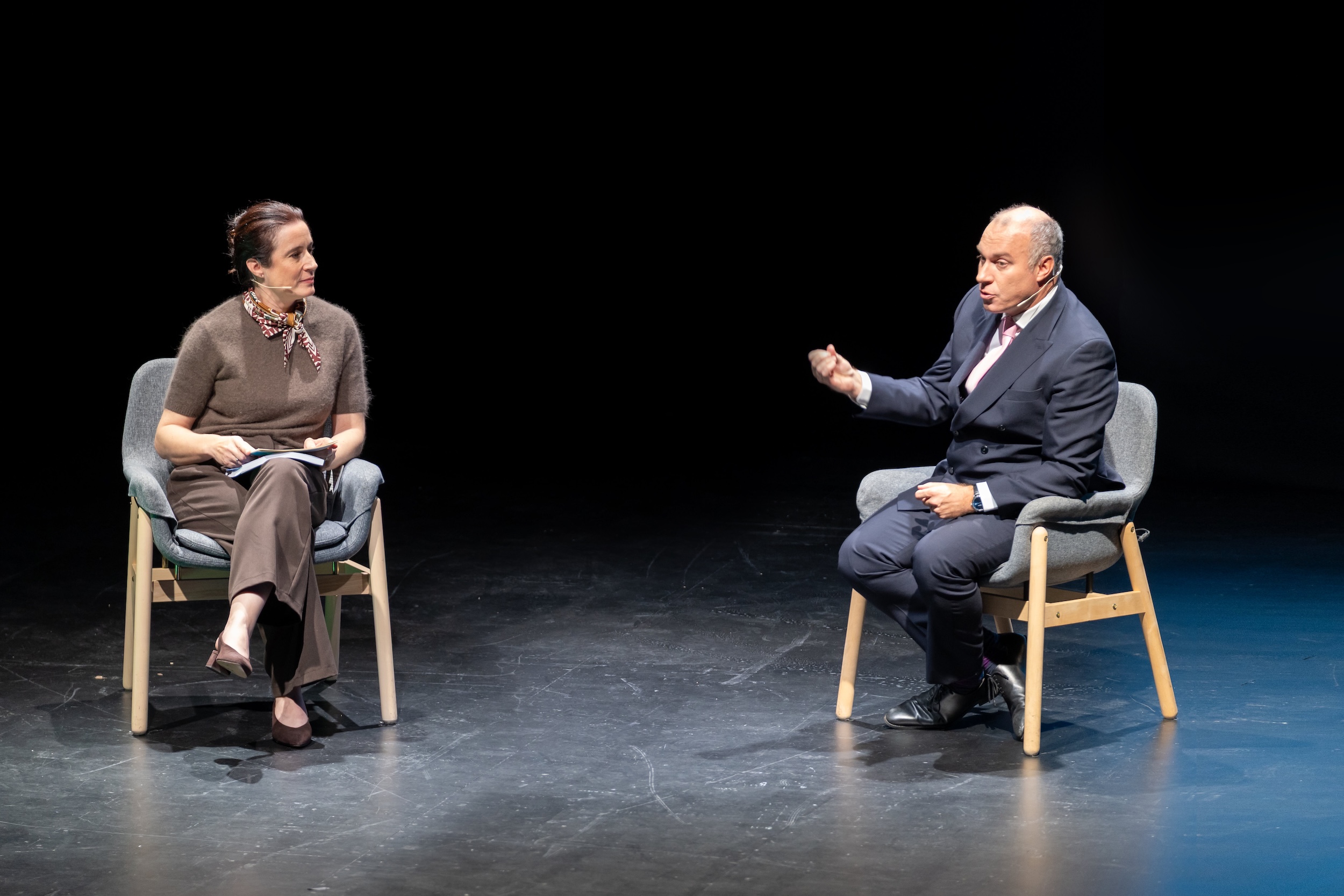
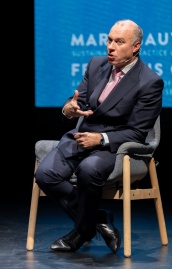
At the Luxembourg Sustainability Forum 2025, François Gemenne interviewed by Marie Sauvignon, IMS Luxembourg.
As a professor in management schools such as HEC, how would you define leadership in sustainable development today?
Leadership means taking the risk of developing new business models. By definition, this goes against the force of habit, against the natural inclination to follow the beaten path that most leaders were trained to follow during their studies. A key challenge therefore also lies in education, particularly in management schools. Leading in sustainable development requires breaking with "business as usual" to allow new economic models to emerge.
François Gemenne
An expert in the geopolitics of the environment and a lead author of the IPCC’s Sixth Assessment Report, François Gemenne is a researcher with the Belgian National Fund for Scientific Research at the University of Liège. He also teaches at Sciences Po, HEC Paris and the Université libre de Bruxelles. He chairs the Sustainable Finance Observatory, the NGO Climate Voices, and the scientific council of the Fondation pour la Nature et l’Homme.
Must Read, Must See
Atlas de l'Anthropocène
Speech at the Luxembourg Sustainability Forum 2025
Speech at the Luxembourg Sustainability Forum 2025
Must Read, Must See
Atlas de l'Anthropocène
François Gemenne, Aleksandar Rankovic (Eème édition, ED. Les Presses de Sciences Po, 2025)
Must Read, Must See
Speech at the Luxembourg Sustainability Forum 2025
Speech at the Luxembourg Sustainability Forum 2025